Sort Algorithms
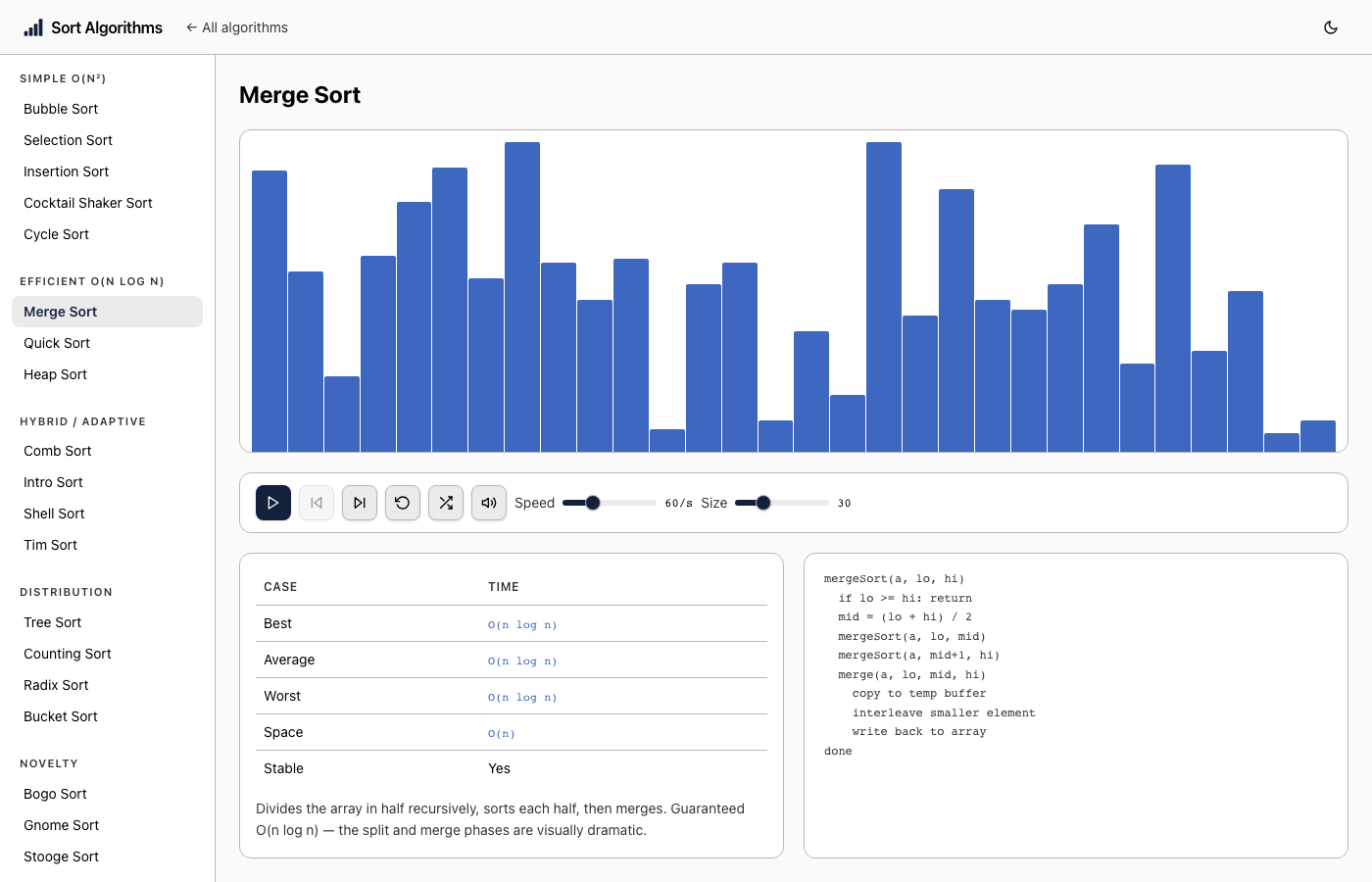
Interactive visualiser for 25+ sorting algorithms with animated bars, step-by-step pseudocode highlighting, and sound mode. Built because time complexity isn't theoretical when you're processing 100k pages.
How It Started
I saw an Instagram post about miracle sort — the algorithm that shuffles an array randomly and checks if it’s sorted, repeating until it works (or the heat death of the universe, whichever comes first). I thought it was funny and fell down a rabbit hole. Did you know Bill Gates authored a paper on the theoretical limitations of pancake sort? Sorting algorithms are one of those topics that seems simple until you look closely, and then it’s endlessly deep.
Why It Actually Matters
The rabbit hole connected directly to my day job. At Squiz, we process 10,000 to 100,000+ page websites — reviewing content, calculating embeddings, querying vector databases, clustering results. At that scale, the difference between an O(n log n) algorithm and an O(n²) one isn’t academic. It’s the difference between a task completing in seconds and never finishing at all. You can’t just dump things into a Lambda and hope for the best.
I kept seeing inefficient choices being made in this space, and I wanted a tool that made the real-world impact of algorithm selection visceral — not just a Big O table in a textbook, but something you could watch and feel.
What It Does
Select any of 25+ algorithms, adjust the array size and speed, and watch it sort in real-time. Bars are colour-coded to show comparisons and swaps as they happen, and the pseudocode panel highlights the current operation so you can follow the logic step by step.
The sound mode maps bar heights to audio frequencies — you can literally hear the difference between merge sort’s methodical sweeps and quicksort’s recursive partitioning. This started as a novelty inspired by the same Instagram clip that kicked the whole project off, but it turned out to be genuinely useful for building intuition.
The Fun Ones
Alongside the classics (merge sort, quicksort, heap sort), the collection includes some algorithms that exist more for entertainment than production use:
- Miracle sort — checks if the array is sorted, and if not, waits and checks again. Relies on cosmic rays flipping bits in memory. Theoretical best case: O(n). Expected case: longer than you have.
- Sleep sort — spawns a timer for each element proportional to its value. Small values wake up first. It technically works.
- Bogo sort — shuffles randomly and checks. The drunk friend of miracle sort.
- Pancake sort — the one Bill Gates wrote about. You can only flip prefixes, like flipping a stack of pancakes with a spatula.
These aren’t practical, but they’re brilliant for understanding why the practical algorithms are designed the way they are.
Why I Built It This Way
Most existing sorting visualisers show bars moving around but don’t connect the animation to the underlying logic. The pseudocode highlighting bridges that gap — you can see what the algorithm is doing and why at the same time. It’s the tool I wanted when I was explaining these concepts to engineers on my team.